
”If I had dropped out that day, nobody would have believed women could run a marathon.” — Kathrine Switzer
She ran, made history, and opened paths for thousands of women around the world.
Some people run to win. Others run to survive. And then there are those incredibly rare people who, with a single step, change the direction of history for many others.
Before there were crowds of women standing at the starting lines of the world’s biggest marathons, before medals, records, sponsors, running clubs, and the global explosion of women in the running world, there was a young woman in a wet sweatshirt, simple running shoes, and quiet courage standing at the starting line of the Boston Marathon in 1967.

Kathrine Switzer did not enter that race wanting to become a symbol.
She did not enter thinking about revolution.
She did not enter imagining that her bib number would travel across decades, continents, and generations.
She simply wanted to run.
”I wasn’t trying to make history. I just wanted to run.” — Kathrine Switzer
But some revolutions begin exactly this way: when a woman decides to occupy a space that the entire world swore did not belong to her.
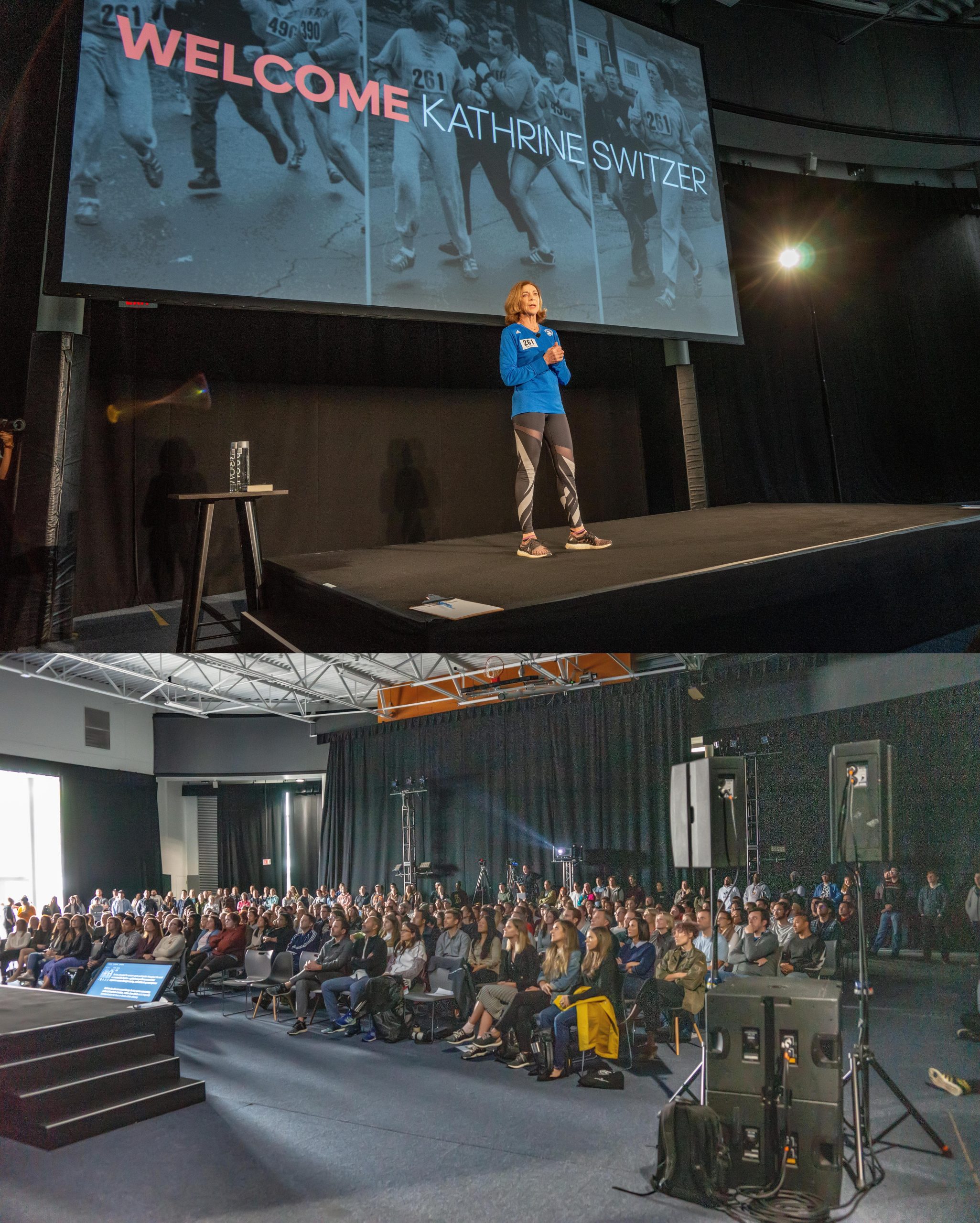
What happened that day went far beyond sports. The image of Kathrine Switzer being attacked during the race became one of the most emblematic photographs of the 20th century, not simply because it showed a woman running, but because it revealed something much greater: the exact moment when fear met resistance. The moment a moving female body challenged entire structures built to keep it still.
Nearly six decades later, the impact of that act continues to echo across every finish line occupied by women around the world.
Today, when we see thousands of women runners crossing cities at sunrise, building communities, transforming health into freedom, discipline into self-esteem, and movement into identity, it is easy to forget that there was once a time when people said women were not even capable of running a marathon. They said their bodies were too fragile, that they could not handle it emotionally, that endurance belonged to men.
Kathrine Switzer ran against all of that, and won far more than a race.
In this exclusive interview for Runners Brasil, Kathrine, now 79 years old, revisits not only the episode that transformed her life, but also the decades of struggle, social impact, growth, and purpose that followed. Approaching 80 years old, she continues to be a luminous presence in the sport, not as a memory of the past, but as an active force for transformation.
Throughout this conversation, Kathrine speaks about courage, aging, discipline, freedom, femininity, community, and the almost invisible power that exists in putting one foot in front of the other when the world expects you to stop.
More than the story of the first woman to officially run the Boston Marathon, this is the story of how one race helped rewrite the place of women in sport and, in a way, in the world itself.
Because some people cross finish lines.
Others cross borders.
Kathrine Switzer did both.
The Day That Changed Everything
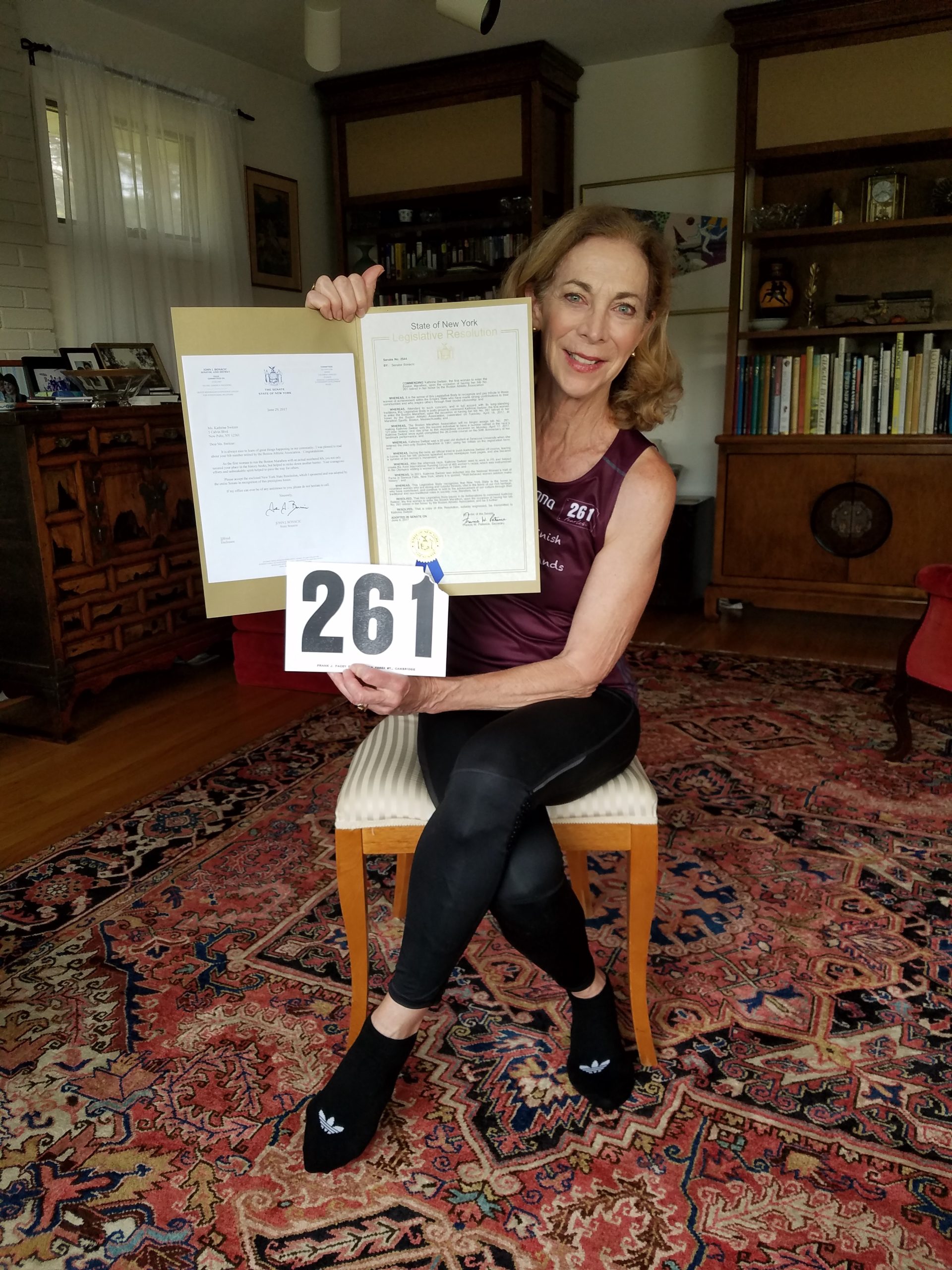
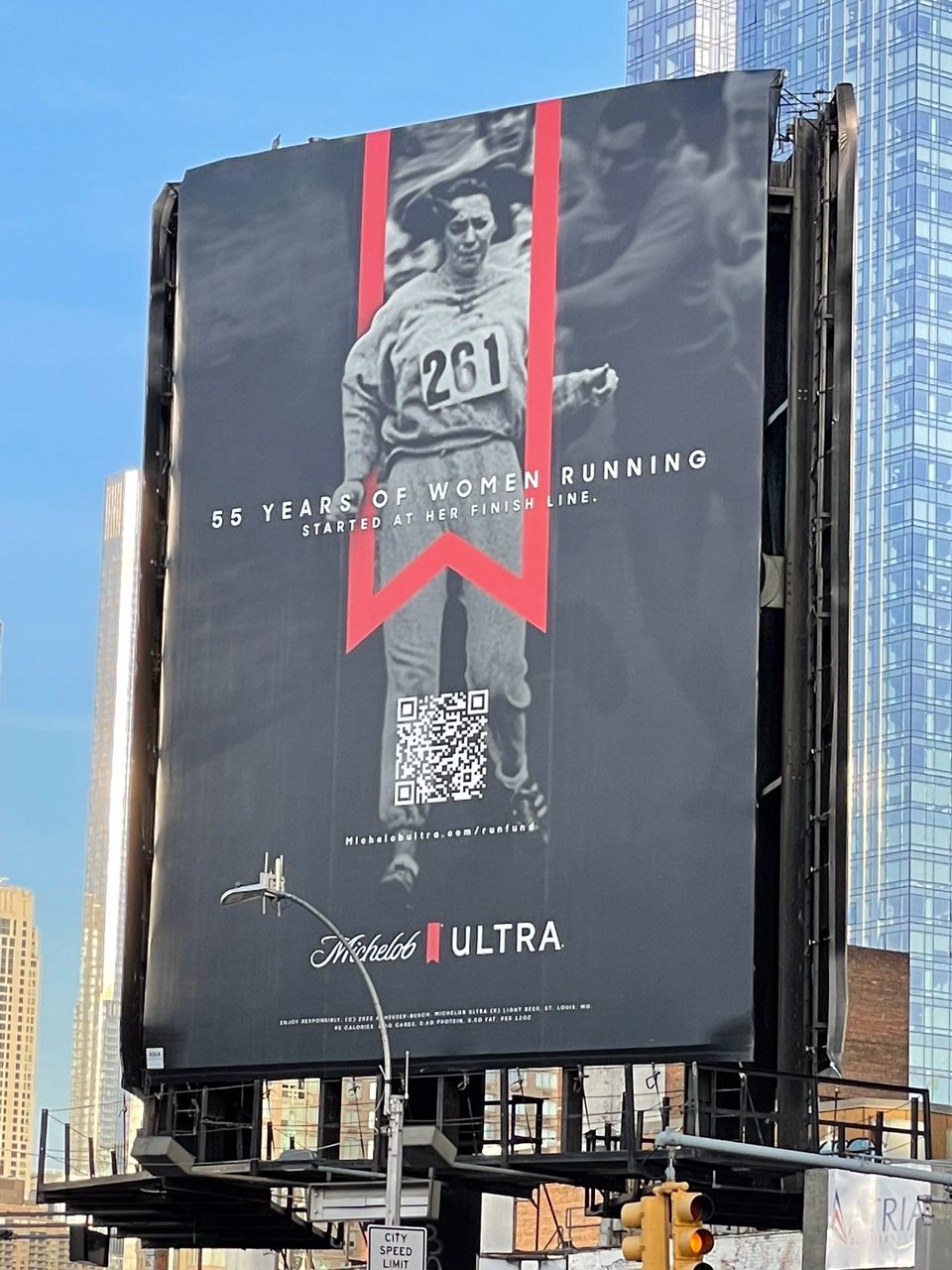
Before the historic photograph, before the number 261 became a global symbol, before crowds of women occupied the streets of the world’s greatest marathons, there was simply a young woman determined to run.
And that was enough to change the world.
Runners Brasil Magazine: Kathrine, when you look back at that defining moment in 1967, did you have any sense of the history you were making, or were you simply a young woman determined to run?
Kathrine Switzer: No, not at all. I was simply a young woman who wanted to run. I was excited, truly thrilled, to be at the start of the Boston Marathon because, to me, it was the greatest race in the world. I wasn’t there to make history; I was there to run 26.2 miles. I had trained hard, earned the right to be there, and I only wanted the chance to do what I loved. The history came later. At the time, it felt personal. Only later did I understand that something much bigger had happened.
”What people see in the photograph is drama. What I felt in that moment was fear, then anger, and then a deep determination.” — Kathrine Switzer
Runners Brasil Magazine: The image of you being confronted during the race became one of the most iconic moments in sports. What was it like to experience that from the inside?
Kathrine Switzer: From the inside, it was frightening, confusing, and everything happened very fast. One moment I was happily running in this magnificent race, and the next moment a furious official was grabbing me and shouting at me to get out of his race. It was shocking!
I was a young woman and suddenly found myself in the middle of an international incident without even understanding it. What people see in the photograph is drama, but what I felt in that moment was fear first, then anger, and then a deep determination.
Runners Brasil Magazine: What gave you the strength to keep running at that moment instead of stepping off the course?
Kathrine Switzer: Very quickly I realized that if I quit, nobody would believe women could run a marathon. They would say, ”See? She was a joke. Women don’t belong here.” And I knew that wasn’t true. I knew I could complete the distance; I had already done it in training. So finishing the race became something bigger than me — it became a responsibility. That realization gave me strength. I think many women know that feeling, when suddenly you understand that what you do next can impact others just as much as yourself.
Runners Brasil Magazine: If you could speak today to that young woman wearing bib number 261, what would you tell her?
Kathrine Switzer: I would say: ”Oh, honey, hold on. Your life is about to become much more difficult, but also much more meaningful than you can imagine.” I would tell her not to be afraid of the struggle, because it is precisely the struggle that will reveal her purpose. And I would tell her something I still deeply believe today: when something happens that seems terrible at the time, it may actually become the doorway to the life you were meant to live.
Runners Brasil Magazine: Beyond that day, what were the greatest obstacles you faced as a woman in running during those early years?
Kathrine Switzer: The biggest obstacle wasn’t one person, or even one rule. It was an entire culture of limitation. People believed women were too fragile, too weak, too emotional, too unsuitable for endurance events. There were no opportunities, little encouragement, and a lot of ridicule. We had to overcome bad science, outdated attitudes, and a great deal of prejudice. But perhaps the most difficult thing of all was that many women had internalized those limitations and were often hostile or threatening toward me. So the work wasn’t only about opening doors; it was helping women believe they had every right to walk through them, and then forgiving them for being unkind.
In 1967, women were still not officially allowed to run the Boston Marathon. Kathrine Switzer registered using her initials, K.V. Switzer, and entered history just a few miles after the starting line.
Running Through Life
As the decades passed, running stopped being just competition. It became language, purpose, identity, and a tool for social transformation.
Runners Brasil Magazine: After that historic race, you continued running marathons around the world. How did your relationship with running evolve over the years?
Kathrine Switzer: At first, running was joy and freedom. Then it became purpose. After that, it became my profession, my platform, and truly the language of my life. Over the years, I became a much better athlete, much more serious and competitive, and eventually I understood that running was giving me not only medals or race times, but also a way to communicate with the world. Running stopped being something I did and became something through which I could serve.
Runners Brasil Magazine: You have had an incredibly long and active life in sport. What has running taught you about endurance, not only physically, but mentally and emotionally?
Kathrine Switzer: Running teaches you that endurance is not always about toughness in the dramatic sense, although there certainly were many long and lonely training runs in very dark, cold, and difficult conditions that truly made me physically and mentally stronger. But endurance is mostly about patience. It is learning that difficult things pass if you keep moving. You discover that panic does not help, that self-pity is exhausting, and that courage often looks very ordinary.
”One foot in front of the other is a profound philosophy. Running taught me that the human spirit can be trained just like the body. You can become stronger in every possible way.” — Kathrine Switzer
Runners Brasil Magazine: As you approach 80 years old, you remain active and inspiring. How do you take care of your body and your health today?
Kathrine Switzer: I take care of myself with respect rather than ego. That is very important. Although I often regret the times I did foolish things to myself out of pure carelessness or postponed important health checkups, I forgive myself and move forward having learned a hard lesson. Today I no longer train to prove anything. I train to be healthy, mobile, energetic, and alive to the world. I keep moving, I stay consistent, I do strength and core work, I recover properly, and I pay attention to my body. I think one of the greatest gifts of age is finally understanding that fitness is not punishment; it is gratitude in action. On my official website, I continue sharing how to stay active in masters running.
”Mindset gets you out the door, discipline keeps you moving when enthusiasm disappears, and consistency creates the miracle.”
Runners Brasil Magazine: What role do consistency, mindset, and discipline play in your longevity?
Kathrine Switzer: Talent is wonderful, but I never had much of it, and I learned early that consistency is what changes your life, and that regular training often overcomes “talent.” Mindset gets you out the door, discipline keeps you moving when enthusiasm disappears, and consistency creates the miracle. I have never believed in waiting for inspiration. I believe in routine, commitment, and purpose. Those are the things that sustain a person over decades. And when you run, inspiration flows! I had my best creative ideas while running. (Seriously, this is a great tip: oxygen reaching the brain through constant movement has been proven to generate new thoughts; and being in nature, with fresh air and sunshine if possible, is extremely inspiring and restorative.)
Runners Brasil Magazine: Has your definition of performance and success changed over time?
Kathrine Switzer: Oh yes, enormously. When I was younger, success often meant improvement, speed, competition, and achievement. And those are wonderful things, but over time success came to mean fully using the gifts I have and helping create opportunities for others. Performance is no longer only about what my body can do on a given day; it is about how I show up in the world, how I continue contributing, growing, and living with courage and joy.
Approaching 80 years old, Kathrine continues:
- running;
• writing;
• speaking;
• leading the 261 Fearless movement;
• inspiring women around the world.
When Women Took Over the Streets
Today, women represent nearly half of marathon runners worldwide. But there was a time when running was considered inappropriate for them. Kathrine witnessed this transformation happen step by step.
Runners Brasil Magazine: Today, women represent around 40% of marathon runners worldwide and, in many races, they are already close to parity — or even the majority in shorter distances.
When you ran Boston in 1967, women were not even officially allowed to participate. When you see starting lines now filled with women, what goes through your mind?
Kathrine Switzer: I feel overwhelming gratitude. And I mean that very deeply. Going from being the only woman with an official bib number in Boston in 1967 to seeing thousands upon thousands of women at starting lines around the world is simply glorious. It is one of the happiest transformations I could ever have imagined. In fact, one of the most beautiful things that happened when I ran the Boston Marathon at age 70, on my 50th anniversary of the race, was that for the first time in the history of the event, men and women were represented equally — 50/50.
I do not look at those starting lines and think, ”Look what happened to me.” I think, ”Look what women have done.” It is magnificent.
”I do not look at those starting lines and think: ‘Look what happened to me.’ I think: ‘Look what women have done.’” — Kathrine Switzer
Runners Brasil Magazine: In your opinion, what barriers still exist for women in sports today, even if they are less visible?
Kathrine Switzer: Many barriers today are more subtle, but they are still very real. Unequal leadership, unequal pay, unequal media attention, safety concerns, cultural discouragement, lack of access, and in many places around the world, outright prohibition. We must never confuse progress with completion. There are still girls being taught not to sweat, not to strive, not to take up space, not to be ambitious with their own bodies. So yes, much has changed, but there is still a great deal of work to be done.
Runners Brasil Magazine: You became not only a runner, but also a communicator as a commentator and author. In your book Marathon Woman, you share your journey in a very personal way. What message do you most hope readers take with them?
Kathrine Switzer: I hope they take this with them: that one ordinary person, by saying yes to a difficult challenge, can create extraordinary change. I want readers to understand that fear is not the enemy. Giving in to fear is the enemy.
I also hope they realize that history is not made only by famous people in grand rooms. Sometimes history is made by a young woman in a wet sweatshirt who SHOWS UP and simply refuses to quit.
I was very personal in my book Marathon Woman because many people thought I had a lot of lucky opportunities, plenty of money, wonderful jobs, and “fame,” when in reality there were many difficult moments and a great deal of heartbreak in my life, just like many women experience. Today, I am happy that my work reaching the public as a commentator, speaker, and author continues to remain a central part of my legacy.
261: The Number That Became a Movement
The number that someone once tried to rip from her chest transformed into a global symbol of female courage. Today, 261 Fearless operates in different countries using running as a tool for self-esteem, leadership, and empowerment.
Runners Brasil Magazine: 261 Fearless has grown into a global movement. What makes running such a powerful tool for women’s empowerment?
Kathrine Switzer: A woman does not need permission to become stronger once she discovers her own power through movement. Running changes posture, energy, self-image, courage, health, community, and possibilities.
It is not just exercise. It is agency.
That is why 261 Fearless exists: to use running as a practical vehicle for confidence, connection, and transformation. 261 Fearless describes its mission as empowering women globally through running and community programs. That is a modest description for a young, powerful, and constantly growing organization.
Women know they are not alone out there; we have their backs.
”I did not want 261 to become a museum piece. I wanted it to stay alive.” — Kathrine Switzer
Runners Brasil Magazine: Why was it important to transform the number 261 into something bigger than your personal story?
Kathrine Switzer: Women around the world started telling me that 261 meant courage to them, fearlessness to them, a turning point in their lives. That moved me deeply.
I realized the number had escaped history and entered the realm of meaning.
And when that happened, I had the responsibility to help make it useful, not merely symbolic. I did not want 261 to become a museum piece. I wanted it to stay alive.
Runners Brasil Magazine: Can you share a story from the movement that deeply touched you?
Kathrine Switzer: There are many, and they are usually not the loudest stories. They are the quiet ones.
A woman who begins by saying, ”I am afraid, I am ashamed, I do not belong here,” and months later stands taller, smiling, encouraging other women and saying, ”Come with me.”
That transformation always moves me.
I have seen isolated women become leaders, women who felt invisible become visible to themselves.
And I have also seen women rise out of poverty because they started running, became stronger, and sought a path through education, training, and self-confidence in order to get jobs and save themselves and their children from generational poverty and ignorance.
THE MOST DRAMATIC AND VISIBLE EXAMPLES OF THIS ARE IN BRAZIL!! (SEE THE BRAZIL SECTION). That is incredibly powerful, that is the real victory.
Runners Brasil Magazine: What does being “fearless” truly mean to you today?
Kathrine Switzer: Fearless does not mean never feeling fear. That is nonsense.
Fearless means feeling fear and moving forward anyway because something else matters more.
Today, fearlessness means fully using your life. It means speaking when silence would be easier. It means making room for others.
It means turning adversity into service. That, to me, is the true meaning of 261.
Brazil: Running, Freedom, and Social Revolution
Kathrine’s connection with Brazil goes far beyond the tracks. The country became one of the most emotional chapters of her international journey.
Runners Brasil Magazine: Have you had any connection or experience with the Brazilian running community? What stood out to you the most?
Kathrine Switzer: YES! THE FOLLOWING TEXT WAS TAKEN FROM MY BOOK MARATHON WOMAN. I SUGGEST YOU READ THE ENTIRE CHAPTER, AS I HAD TO EDIT IT FOR LENGTH.
What stands out to me most about Brazil is the enthusiasm, warmth, and community spirit that seem to be naturally woven into the country’s running culture. Brazilian runners bring an incredibly human energy to the sport. When I first visited the beach in Rio around 1980, I was struck by the energy surrounding body culture. The women were very fun, full of warmth, community spirit, and joy in movement and the freedom of their own bodies. I felt that running would come naturally to them because they would love running through the streets.
I was first approached about organizing a race in Brazil by Eleonora Mendonça, who at the time was the country’s top long-distance female runner and knew the key people within the Brazilian sports organization. At Avon, we decided to do it because Avon was popular in Brazil and I wanted a strong and visible South American country to add to our global campaign to include the women’s marathon in the Olympic Games. We needed 24 countries and 3 continents for the event to qualify for Olympic inclusion — and even that did not guarantee anything.
When I met with the president of the Brazilian athletics federation, he told me that Brazilian women would never run through the streets (I do not think he spent much time at the beaches!) and that he would attend the race because it was his duty, but he would not bring his wife, nor would he allow (allow!!) his 14-year-old daughter to attend. That comment truly saddened me because a 14-year-old girl would have loved it.
But there was another aspect of Brazilian life that I also wanted to address: the enormous number of women living in extreme poverty. Running does not require fashionable equipment. Avon would provide all amenities free of charge, including a red knit tank top. It was a new setting for my old belief: opportunity is everything.
Three thousand women showed up for the first race in Rio. By the third race, in São Paulo, there were 10,000. You simply cannot ignore 10,000 women running through the streets wearing shorts. Many saw it as a joyful celebration; others were able to leave poverty behind for a little while; perhaps some even ran for the free shirt, a medal, and a lipstick — things they had never had before.
These were women without shoes. And I do not mean Adidas or Nike. I mean they literally owned no shoes and ran barefoot wearing Avon shirts. The race gave them a sense of recognition and significance that felt as unfamiliar as a medal itself.
With a new sense of self-esteem and confidence born from that program, many, many of these women moved on to better lives. They learned to write and sent me letters. They got jobs and completed their education. And they most certainly educated their children.
A running event turned into a social revolution.
And it gave me some of the proudest moments of my life.
Sometimes, when I felt discouraged or so exhausted from work and travel that I could barely stand, I would think of those poor women and know that every effort had been worthwhile.
TV Globo broadcast the São Paulo event on the nightly news every evening for an entire week. The aerial footage of the women was simply marvelous. Even Mr. President himself was impressed, as he should have been; he was on television every night too. I was happy because I had secured another safe IOC vote. But best of all was that we transformed and empowered the lives of hundreds, perhaps thousands, of women.
”A running event turned into a social revolution.” — Kathrine Switzer
Runners Brasil Magazine: Why do you think running has become such a powerful global movement, especially among women?
Kathrine Switzer: Because it answers so many needs at once. It is healthy, financially accessible, democratic, time-efficient, and deeply empowering. Women especially have discovered that running offers not only physical fitness, but also identity and strength. It allows women to claim time for themselves, space for themselves, and confidence in themselves. Once that happens, the effect spreads into family, work, community, and leadership. Running may look simple on the outside, but socially it is revolutionary.
Runners Brasil Magazine: How do you see the future of running, both as a sport and as a social movement?
Kathrine Switzer: Running will continue growing, especially among women, older runners, beginners, and communities that historically have been excluded. As a sport, it will continue evolving. As a social movement, it can become even more powerful by focusing on access, safety, health, and leadership.
I am especially interested in how running can reach women who still have very little freedom.
Talent exists everywhere. It only needs an opportunity. Our job is to create that opportunity.
The impact of women’s races organized in Brazil:
- thousands of women on the streets;
• social inclusion;
• access to sport;
• self-esteem;
• education;
• financial independence;
• female visibility.
Legacy in Motion
Nearly 60 years after the historic Boston Marathon, Kathrine continues looking forward.
Runners Brasil Magazine: As you approach 80 years old and nearly 60 years since that historic race, how do you reflect on your legacy?
Kathrine Switzer: With gratitude, but also with perspective. Legacy is not a monument; legacy is what continues moving after you. If my life has helped women believe in their own strength, claim their place, and create opportunities for others, then that is already enough for me. Of course, I am proud of what happened, but I am even more proud not of the photograph, but of everything that came after it.
”Legacy is not a monument. Legacy is what continues moving after you.”
Runners Brasil Magazine: What kind of world for women in sport do you still hope to see?
Kathrine Switzer: I want women to be safe in sport, fairly paid in sport, respected in sport, represented in leadership positions, and free to pursue excellence without having to apologize for it. And I want this not only in wealthy or progressive places, but everywhere, especially everywhere.
Runners Brasil Magazine: Do you still have personal goals or dreams that you have not yet achieved?
Kathrine Switzer: Absolutely. I do not think life should become merely an exercise in looking backward. My greatest ambition now is to continue building meaningful pathways for women through 261 Fearless, through speaking, writing, and whenever possible, through personal example.
I still want to reach women who have not yet had the opportunity to discover what movement can do in their lives.
As long as that work remains unfinished, so do I. Kathrine remains active in writing and in the leadership and programs of 261 Fearless. She keeps showing up!
Runners Brasil Magazine: What continues to inspire you to keep moving forward?
Kathrine Switzer: Women inspire me. Always. Especially women who begin in doubt and end in strength. I am inspired by courage in everyday life, by resilience, by generosity, and by the possibility of social transformation that begins with something as simple as a pair of running shoes. And I also have to say this: I continue to be inspired by movement itself.
Running still makes me feel free, grateful, and alive.
Runners Brasil Magazine: If your life had one single message written across it, what would it be?
Kathrine Switzer: Be fearless, free, and grateful.
And perhaps one more line underneath: Do not wait for permission; just show up.
The Woman Behind the Symbol
Beyond the activist. Beyond the athlete. Beyond the icon, there is a woman who still deeply believes in the power of human movement.
Runners Brasil Magazine: What does running mean to you today compared to what it meant in 1967?
Kathrine Switzer: It still means those things, but now it also means home.
It has been the great constant in my life.
Running gave me health, friendships, work, purpose, a way to understand the world, and the great love of my life, my husband, Roger Robinson* (renowned runner and author).
It began as something I loved; it became the way I lived my life.
Runners Brasil Magazine: Kathrine, after everything you have lived through, how would you define what life means to you today?
Kathrine Switzer: Life means growth through challenges, service through experience, and joy through movement and connection.
I think life asks each one of us, over and over: ”What will you do with what you have been given?”
I have tried to answer that question by using my opportunities to create opportunities for others. To me, that is a life well lived.
”Do not wait until you feel ready. Start now. Courage does not come first. Action comes first — and courage follows.”
Runners Brasil Magazine: To close, what message would you like to leave for women around the world who are still finding their voice and their path?
Kathrine Switzer: Do not wait until you feel ready.
Start now. Show up. Start where you are, with what you have, in the body and life you have today.
Courage does not arrive first. Action comes first, and courage follows.
Trust yourself enough to begin. You are far more powerful than you have been told, and once you discover that power, please use it not only for yourself, but also to open the way for other women.
If life does not give you an opportunity, give yourself that opportunity.
It is there.
And thank you for this opportunity!
Kathrine Switzer did not just change sports.
She changed the way millions of women see their own bodies, their own strength, and their own place in the world. And perhaps that is the true meaning of a marathon: to keep moving forward even when people tell you that you do not belong on that road.
She ran. She belonged. She dreamed. She achieved.
And she opened the path for many women.